


When two companies come together in a merger or acquisition, it’s more than just a financial or strategic move it’s the collision of two distinct workplace cultures. While leadership often focuses on legal, operational, and financial alignment, culture clash is one of the most underestimated threats to a successful M&A. This is where HR plays a silent but powerful role guiding the organization through the emotional, behavioral, and cultural complexities that follow such major transitions.
The first step for HR is to assess the cultural DNA of both organizations. What values do they live by? How do they communicate, celebrate, resolve conflict, or define success? A deep cultural audit helps identify overlaps, gaps, and potential points of friction. HR must then act as a translator between these cultures building a roadmap that aligns people, values, and behaviors to support a cohesive identity post-merger.
HR must also take the lead in communicating changes transparently to all stakeholders. Uncertainty breeds fear, which can quickly turn into disengagement or attrition. Clear messaging around new structures, leadership roles, benefits, and expectations delivered consistently and compassionately can greatly ease anxieties. Involving leaders from both sides as culture champions, encouraging feedback, and recognizing early wins are also powerful tools to drive positive momentum.
Ultimately, a merger’s success depends on people more than paperwork. HR professionals who understand this can become the glue that holds everything together building bridges instead of barriers, and ensuring that culture becomes a strength, not a casualty, in the M&A journey.
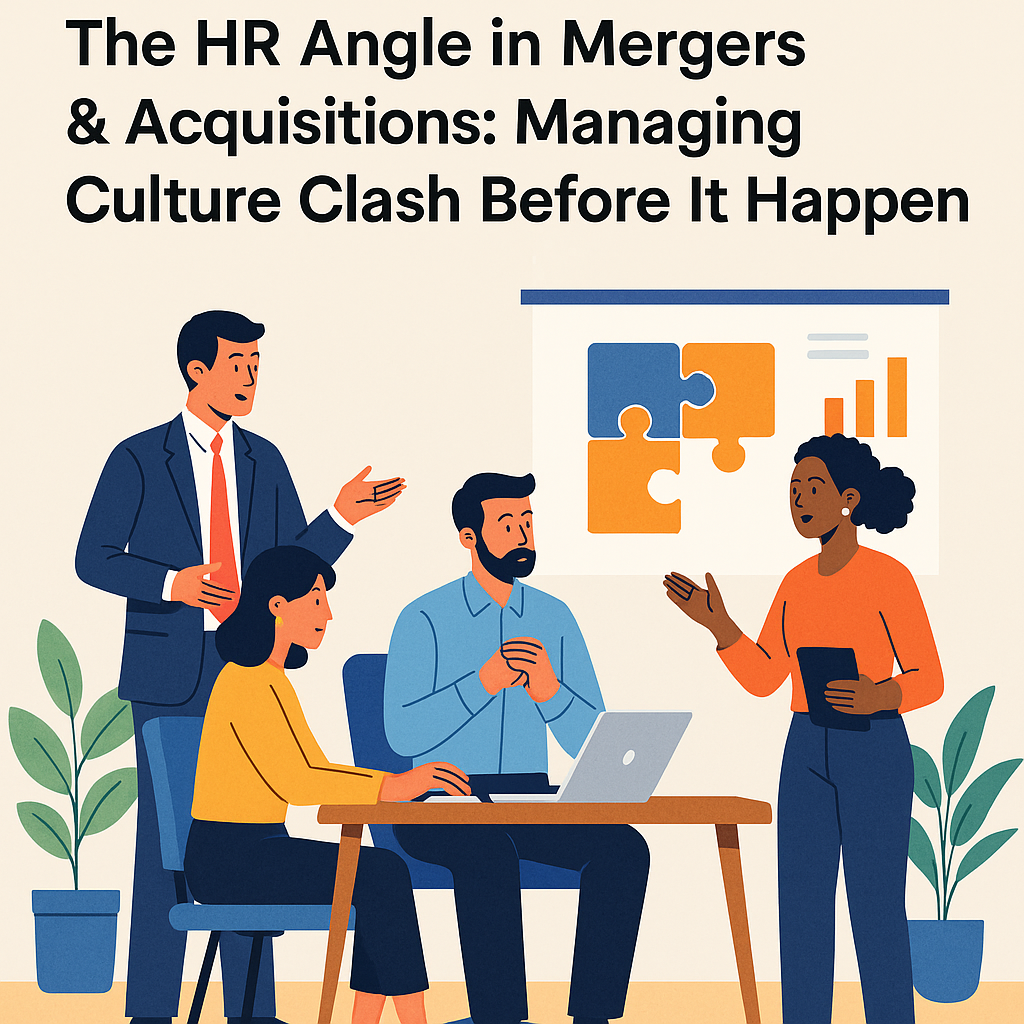
When two companies come together in a merger or acquisition, it’s more than just a financial or strategic move it’s the collision of two distinct workplace cultures. While leadership often focuses on legal, operational, and financial alignment, culture clash is one of the most underestimated threats to a successful M&A. This is where HR plays a silent but powerful role guiding the organization through the emotional, behavioral, and cultural complexities that follow such major transitions.
The first step for HR is to assess the cultural DNA of both organizations. What values do they live by? How do they communicate, celebrate, resolve conflict, or define success? A deep cultural audit helps identify overlaps, gaps, and potential points of friction. HR must then act as a translator between these cultures building a roadmap that aligns people, values, and behaviors to support a cohesive identity post-merger.
HR must also take the lead in communicating changes transparently to all stakeholders. Uncertainty breeds fear, which can quickly turn into disengagement or attrition. Clear messaging around new structures, leadership roles, benefits, and expectations delivered consistently and compassionately can greatly ease anxieties. Involving leaders from both sides as culture champions, encouraging feedback, and recognizing early wins are also powerful tools to drive positive momentum.
Ultimately, a merger’s success depends on people more than paperwork. HR professionals who understand this can become the glue that holds everything together building bridges instead of barriers, and ensuring that culture becomes a strength, not a casualty, in the M&A journey.